
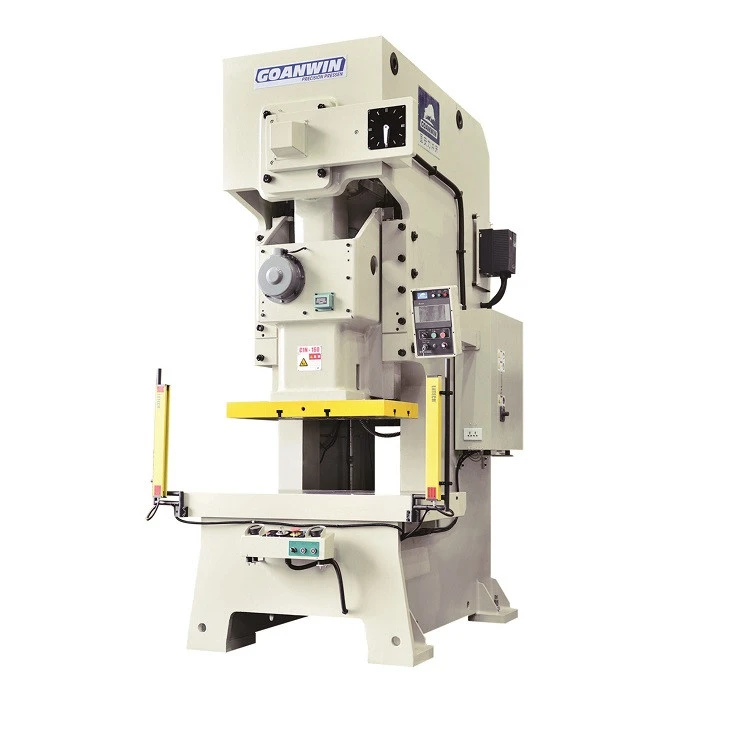
C1N mechanical presses.
Compact power, broad range.
Thirteen C1N models cover 15 to 400 tons with fixed- and variable-speed configurations, adjustable slides and die-cushion options on larger models.
Single-point presses for focused tooling and flexible production.
The C1N range combines a compact C-frame layout with a broad selection of tonnage, stroke and die-height combinations.
Model selection should account for rated tonnage point, usable bolster area, slide area, shut height, required speed and the load path through the die.
Machine, controls, components and production context.
Open any image for a larger view. The component diagram identifies the major mechanical assemblies within the press frame.
C1N series specifications.
The C1N-80 and C1N-110 columns are highlighted because these models are currently emphasized for North American review.
Scroll horizontally to compare every model. Values containing two figures correspond to the V / H configurations shown in the source table.
13 models / 18 specifications| Specification | Unit | C1N-15 | C1N-25A | C1N-25 | C1N-35 | C1N-45 | C1N-60 | C1N-80 | C1N-110 | C1N-160 | C1N-200 | C1N-260 | C1N-315 | C1N-400 |
|---|---|---|---|---|---|---|---|---|---|---|---|---|---|---|
| Type | — | V | V | V / H | V / H | V / H | V / H | V / H | V / H | V / H | V / H | V / H | V / H | V |
| Capacity | Ton | 15 | 25 | 25 | 35 | 45 | 60 | 80 | 110 | 160 | 200 | 260 | 315 | 400 |
| Rated tonnage point | mm | 1 | 3.2 | 3.2 / 1.6 | 3.2 / 1.6 | 3.2 / 1.6 | 3.2 / 1.6 | 4 / 2 | 4 / 2 | 6 / 3 | 6 / 3 | 6 / 3 | 7 / 3.5 | 8 |
| Stroke per minute — variable | SPM | 120–180 | 60–140 | 60–140 / 130–200 | 40–120 / 110–180 | 40–100 / 100–150 | 35–90 / 80–120 | 35–80 / 80–120 | 30–60 / 60–90 | 20–50 / 40–70 | 20–50 / 50–70 | 20–40 / 40–50 | 20–40 / 40–50 | 20–35 |
| Stroke per minute — fixed | SPM | 130 | 110 | 110 | 85 | 75 | 65 | 65 | 50 | 35 | 35 | 30 | 30 | 30 |
| Stroke | mm | 60 | 80 | 60 / 30 | 70 / 40 | 80 / 50 | 120 / 60 | 150 / 70 | 180 / 80 | 200 / 90 | 200 / 100 | 250 / 150 | 250 / 150 | 300 |
| Die height | mm | 200 | 195 | 200 / 215 | 220 / 235 | 250 / 265 | 310 / 340 | 340 / 380 | 360 / 410 | 460 / 510 | 460 / 510 | 500 / 550 | 500 / 550 | 550 |
| Slide adjustment | mm | 50 | 50 | 50 | 55 | 60 | 75 | 80 | 80 | 100 | 110 | 120 | 120 | 120 |
| Slide area | mm | 300×230×50 | 300×230×50 | 300×230×50 | 360×250×50 | 400×300×60 | 500×360×70 | 560×420×70 | 650×470×80 | 700×550×90 | 850×630×90 | 950×700×100 | 950×700×100 | 1050×840×100 |
| Bolster area | mm | 680×300×70 | 680×300×70 | 680×300×70 | 800×400×70 | 850×440×80 | 900×500×80 | 1000×550×90 | 1150×600×110 | 1250×800×410 | 1400×820×160 | 1500×840×180 | 1500×840×200 | 1800×950×200 |
| Shank hole | mm | Ø38.1 | Ø38.1 | Ø38.1 | Ø38.1 | Ø38.1 | Ø50 | Ø50 | Ø50 | Ø65 | Ø65 | Ø65 | Ø65 | Ø70 |
| Main motor | kW.p | 2.2×6 | 4×4 | 4×4 | 4×4 | 5.5×4 | 5.5×4 | 7.5×4 | 11×4 | 15×4 | 18.5×4 | 22×4 | 30×4 | 37×4 |
| Air pressure | kg/cm² | 6 | 6 | 6 | 6 | 6 | 6 | 6 | 6 | 6 | 6 | 6 | 6 | 6 |
| Press precision | — | GB (JIS) 1 class | GB (JIS) 1 class | GB (JIS) 1 class | GB (JIS) 1 class | GB (JIS) 1 class | GB (JIS) 1 class | GB (JIS) 1 class | GB (JIS) 1 class | GB (JIS) 1 class | GB (JIS) 1 class | GB (JIS) 1 class | GB (JIS) 1 class | GB (JIS) 1 class |
| Press dimensions | mm | 1236×856×1920 | 1280×850×2200 | 1280×850×2200 | 1380×900×2400 | 1600×950×2500 | 1600×1000×2800 | 1800×1180×3000 | 1900×1300×3200 | 2300×1400×3800 | 2615×1690×4075 | 2780×1850×4470 | 2780×1850×4500 | 3250×2150×4600 |
| Die cushion capacity | Ton | — | — | — | 2.3 | 2.3 | 3.6 | 3.6 | 6.3 | 10 | 14 | 14 | 14 | 14 |
| Die cushion stroke | mm | — | — | — | 50 | 50 | 70 | 70 | 80 | 80 | 100 | 100 | 100 | 100 |
| Die cushion effective area | mm² | — | — | — | 300×230 | 300×230 | 350×300 | 450×310 | 500×350 | 650×420 | 710×480 | 810×480 | 810×480 | 810×480 |
Specifications are presented from information provided by the manufacturer. Confirm the final working envelope for the selected material grade, yield strength, surface, controls, electrical standard and destination requirements.
Match the model to the work.
Share the part, material, die footprint, calculated load, stroke, speed and production target. We will help organize the selection review.